Selecting a cold forming machine manufacturer in China depends on your target profile geometry, material thickness range, production line integration requirements, and the verification depth your procurement team can apply before committing capital. Chinese manufacturers have scaled in-house CNC machining, roll tooling fabrication, and export-proven delivery records across Jiangsu, Zhejiang, Hebei, and Guangdong. US procurement managers who approach the process with structured technical criteria consistently find viable, export-proven suppliers across these regions. This guide gives you the evaluation framework to separate that tier from the trading companies and assemblers that dominate search results.
This guide covers conventional cold roll forming lines and integrated production systems for commercial, industrial, automotive, construction, furniture, and warehousing applications processing materials up to 3.0 mm in single-speed or servo multi-profile configurations. It does not cover: long-span stadium roof panel systems, blast-resistant enclosure profiles, equipment subject to continuous fatigue loading from heavy-dynamic-cycle manufacturing environments, high-speed packaging integration above 20 m/min, composite material or elastomer co-extrusion lines, or lines incorporating post-forming heat treatment processes.
Why Cold Forming Equipment Sourcing from China Produces Different Results by Supplier Tier
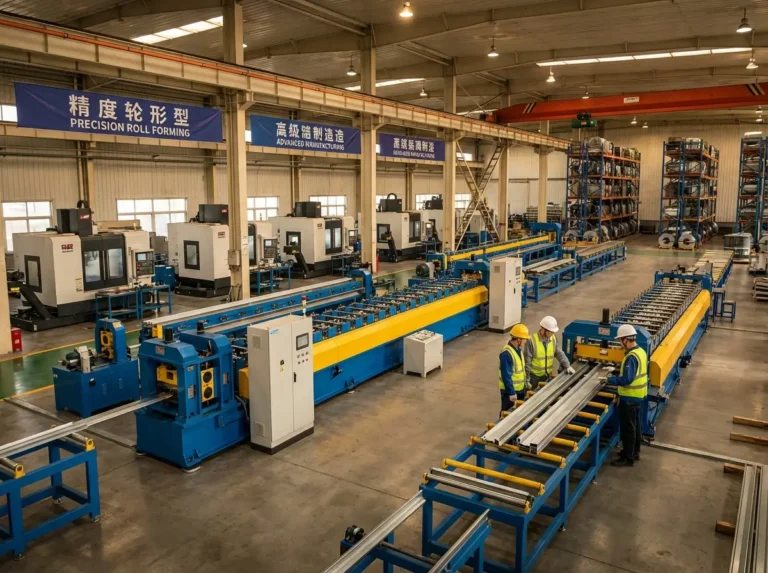
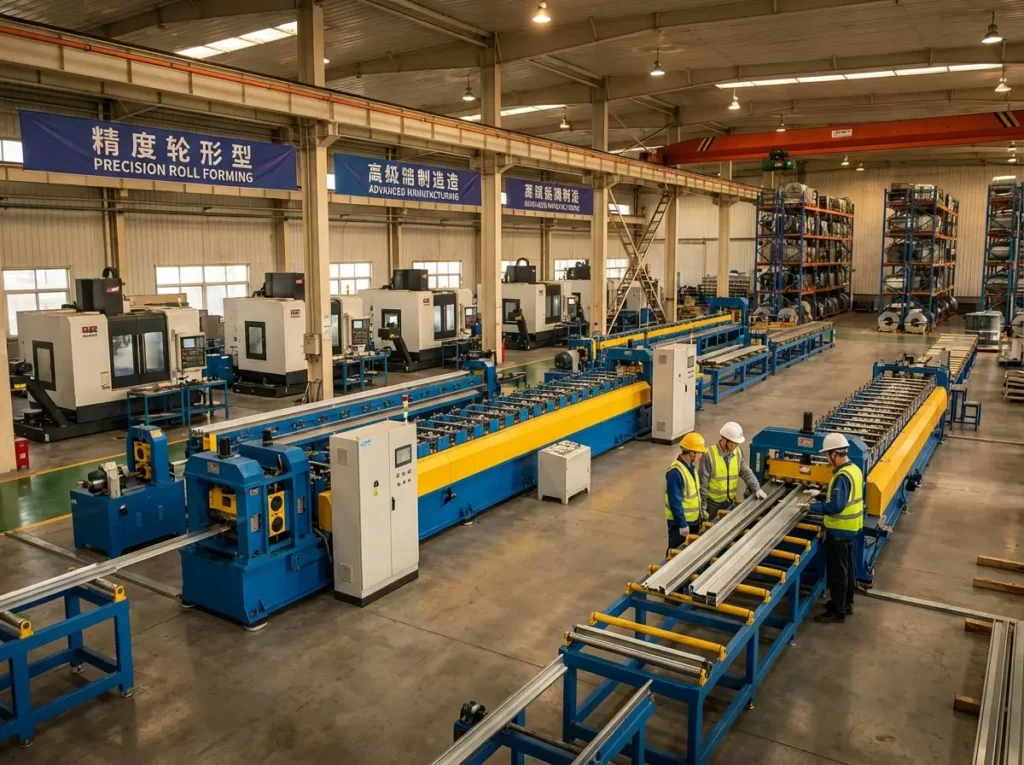
Cold forming machine sourcing from China varies by supplier tier, regional specialization, and in-house engineering depth, with direct manufacturers offering meaningfully different value propositions than trading companies or subcontract assemblers across customization, tolerance control, and after-sales support dimensions. The Chinese cold roll forming supply chain has developed beyond low-cost commodities into a production ecosystem where manufacturers operate dedicated CNC machining centers, multi-axis forming test rigs, and in-house roll tooling fabrication — capabilities that determine whether a line performs to your tolerance spec after installation.
We have worked with demanding domestic and overseas buyers across automotive, construction, and warehousing sectors, and in each case the decision came down to verifiable factory capability rather than country of origin. When we apply the same evaluation framework to Tier-1 Chinese manufacturers — founding year, production floor area, in-house versus outsourced machining, testing equipment on-site — we find that cost-adjusted capability is consistently competitive with mid-market domestic suppliers in purlin and panel categories at a significantly different capital threshold. When US buyers request proposals from Chinese manufacturers with in-house R&D teams, profilers, roughness testing equipment, and hardness testers on the production floor, the resulting line performance data is directly comparable to European benchmarks.
What Cold Forming Machines Are and Which Types Match Your Production Needs
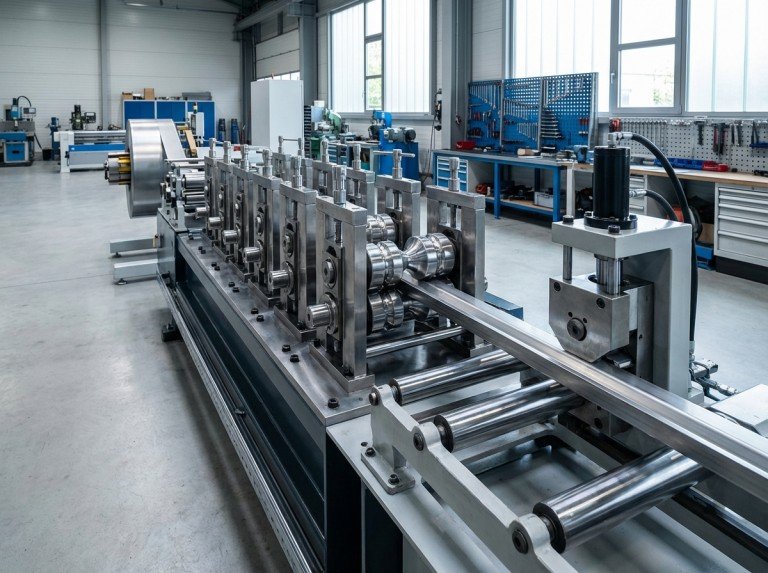
Cold roll forming machine selection for a given production application depends on target profile cross-section complexity, coil material grade and thickness range, required line speed in meters per minute, and whether downstream operations — punching, welding, or packaging — must be integrated inline. A roll forming machine progressively bends continuous metal coil strip through a sequential series of roller stations, each station applying incremental deformation until the finished cross-section is achieved. This guide focuses on cold roll forming — progressive bending of continuous coil to produce a finished cross-section — which differs from cold forming in the compression-based sense (property modification through pressure without shape change, used in fastener and bearing production) and from cold heading (discrete fastener blank reshaping through die-and-punch force). Most US buyers evaluating Chinese manufacturers are sourcing roll forming lines, not cold heading or cold pressing equipment.
Purlin and Light-Gauge Structural Forming Lines
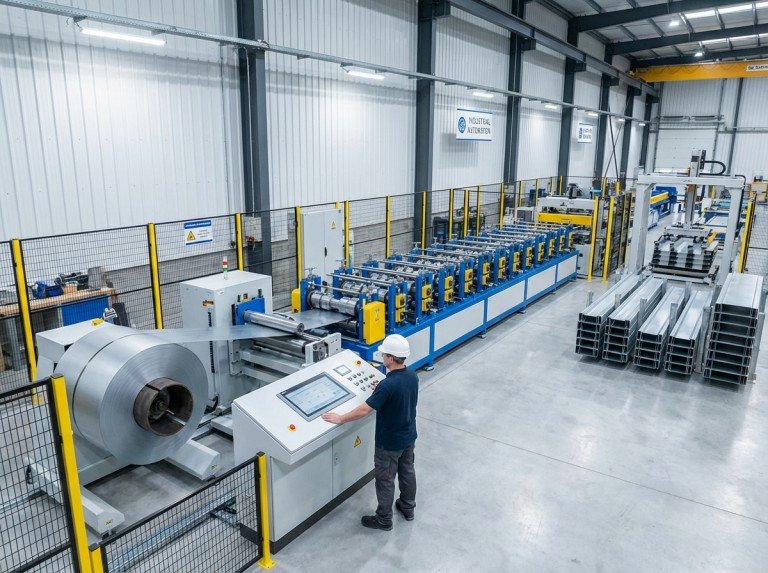
Purlin forming lines for C, Z, and Sigma cross-sections typically process galvanized steel coil from 1.2 mm to 3.0 mm thickness, with servo-controlled web punching integrated inline to produce connection-ready framing members. Line speeds vary by servo specification and station count, with typical ranges up to 12–18 m/min depending on profile complexity and material thickness. We configure purlin lines with quick-change cassette tooling systems when buyers need to switch between C and Z profiles on the same line without full roll dismounting.
Panel and Roof Deck Roll Forming Systems
Panel and roof deck forming systems vary by corrugation geometry, base metal selection between galvanized and pre-painted coil, and whether the line requires a flying cut-to-length or stop-cut configuration depending on production volume. Our panel line configurations pair HSLA, galvanized, and aluminum substrate with rollers manufactured from GCr15 bearing steel with hard chrome surface treatment to sustain dimensional tolerance across long production runs.
Specialty Profile and Custom Section Machines
Custom profile forming lines depend on section complexity, springback behavior of the target alloy, and the number of forming stations required to achieve the finished geometry without surface marking or edge wave. We design custom roll sequences using CAD/CAM simulation of the forming progression before tooling is cut, which reduces first-article correction cycles.
Integrated Production Lines with Punching, Welding, and Packaging
Integrated lines that combine roll forming with inline hydraulic or servo punching, resistance or MIG welding, and automatic stacking and packaging modules require synchronized PLC control across all process stations. Siemens and Mitsubishi PLC platforms are widely specified on export lines because they support English-language programming interfaces and broad technician familiarity in US facilities; alternative platforms may be appropriate depending on your facility’s existing controls expertise and maintenance staffing.
How Most Buyers Misjudge Chinese Cold Forming Manufacturers Without Applying Verifiable Capability Criteria
Chinese cold forming manufacturers in the top supplier tier consistently meet European benchmark tolerances for profile geometry, inspection documentation, and after-sales service — a result that buyers reach only when they evaluate in-house machining capability, export footprint, and inspection equipment inventory rather than country of origin alone. The assumption that all Chinese cold forming manufacturers share equivalent capability, without verifying in-house machining versus subcontract assembly, is the single most common source of procurement failure in this category.
We consistently verify manufacturer capability by requesting profiler scans of completed profile cross-sections, roughness test data from roll surfaces, and hardness test certificates for the roll material before accepting any supplier’s tolerance claims. When we apply the same evaluation framework to Tier-1 Chinese manufacturers as we apply to any domestic or European alternative, we find that cost-adjusted capability is consistently competitive with mid-market domestic suppliers across purlin and panel categories — a finding that holds when buyers evaluate in-house machining capacity, export deployment records, and on-site testing equipment rather than country of origin alone.
When the wrong assumption is made about equivalent capability without verification, the result is often dimensional tolerance drift beyond ±0.3 mm on critical profile flanges — a threshold appropriate for structural purlin applications, though automotive and precision profiles may require ±0.1 mm or tighter depending on downstream fitting requirements. Confirm your application’s specific tolerance requirement before shortlisting any manufacturer. In projects where buyers prioritize price alone during initial shortlisting, we typically find that critical documentation gaps in wiring diagrams and spare parts lists require additional verification before the machine can be safely commissioned by the buyer’s electrical team.
What Separates a Tier-1 Cold Forming Machine Manufacturer from a Trading Company or Assembler
Tier-1 cold forming manufacturer selection for complex, customized production lines depends on in-house R&D depth, direct tolerance control over roll tooling, and after-sales service structure, with trading companies and subcontract assemblers presenting fundamentally different risk profiles across these dimensions. We evaluate every prospective manufacturing partner against eight dimensions before recommending them to production projects.
| Evaluation Dimension | Direct Manufacturer | Trading Company | Subcontract Assembler |
|---|---|---|---|
| R&D and custom design | In-house engineering team | Relayed to factory | Limited or none |
| Tolerance and QC control | Direct on production floor | Indirect, variable | Variable, unverified |
| Lead time reliability | Higher, milestone-trackable | Lower, factory-dependent | Variable |
| Spare parts response | Same facility, immediate | Third-party sourced | Third-party sourced |
| Communication depth | Direct engineering team | Sales intermediary | Mixed |
| Profile inspection tools | Profiler, roughness tester, hardness tester on-site | Outsourced or absent | Absent |
| Best fit for | Complex customized projects | Standard machines, fast quotes | Low-volume, simple spec |
When a Trading Company Makes Strategic Sense
Trading companies deliver fastest turnaround for standard, catalog-specification machines where no customization is required, the buyer has prior experience commissioning similar lines, and after-sales risk is accepted. We do not recommend trading companies for projects involving multi-profile servo changeover, integrated punching or welding modules, or non-standard coil thickness ranges.
How to Identify a True Direct Manufacturer Before Visiting
Request a live video walkthrough of the CNC machining center and ask the guide to pan across the roll tooling in-process on the grinding machine. A direct manufacturer can show you rolls being cut and ground for your order. A trading company or assembler cannot.
A 12-Factor Supplier Evaluation Checklist for Cold Forming Equipment Sourcing
Supplier qualification for a Chinese cold forming machine manufacturer depends on verifying production capability across at minimum twelve sequential dimensions, with each factor representing an independent failure mode if left unconfirmed before contract signing. We apply this checklist in sequence on every sourcing engagement. We cannot confirm certification currency from a certificate image alone — we request the registrar’s online verification record before treating ISO 9001 status as active.
- Factory founding year and operational history – Verify registered business license and years of active production
- In-house machining capability – Confirm CNC machining centers, grinding equipment, and fabrication are on-site, not outsourced
- R&D team and design process – Verify dedicated engineering staff and CAD/CAM design workflow for forming sequence development
- Testing equipment inventory – Confirm access to profiler, roughness testing machine, hardness tester, and forming-machine-specific test rigs
- 5a. Multi-thickness capability within a material family – Verify that the manufacturer can configure the line across your required thickness range within a single material grade (e.g., galvanized coil from 1.2 mm to 3.0 mm) without roll tooling substitution
- 5b. Cross-material capability claims – If the manufacturer claims a single line handles both HSLA and aluminum substrate, confirm that separate roll tooling sets and forming station reconfiguration are included; single-setup cross-material operation across these grades is not mechanically equivalent due to differences in yield strength, springback coefficient, and density
- Tolerance control documentation – Request dimensional inspection reports with profiler scan data from completed projects
- ISO 9001 quality practice confirmation – Verify that the certificate scope text includes “roll forming machine manufacturing” or “cold forming equipment design and production.” If scope language reads only “metal fabrication services” or “metal parts manufacturing,” request registrar clarification on whether cold forming machine assembly is explicitly covered. Confirm certificate currency with the issuing registrar directly; ISO 9001 certificates are valid for three-year cycles, and if no surveillance audit date is shown, treat the certificate as unverified until the registrar confirms active status
- Overseas customer deployment records – Request references or delivery records from US, European, or Australian buyers with contact verification
- Electrical standards compliance – Confirm machine electrical systems can be configured to US voltage and frequency standards and verify PLC brand compatibility
- Lead time control record – Ask for on-time delivery rate data and review milestone-based payment terms in contract
- Engineering communication capability – Assess technical staff’s direct communication ability in English beyond sales-layer fluency
- After-sales service structure – Verify spare parts inventory for your machine model, remote diagnostic capability, onsite commissioning availability, and English-language manual quality
Regional Specialization Among Chinese Cold Forming Manufacturers and What It Means for Lead Times
Regional manufacturer selection for cold forming line sourcing varies by machine type specialization, regional tooling supply chain depth, and average lead time performance, with Jiangsu and Zhejiang clusters offering stronger export orientation and automation integration capability than generalist regions. We target specific regions based on application type to reduce both lead time and technical alignment risk.
Zhejiang: Servo-Controlled and Automation-Integrated Lines
Zhejiang manufacturers, particularly in the Hangzhou and Ronen clusters, lead in servo-controlled multi-profile changeover systems and automation-integrated forming lines. Lead times for standard servo purlin lines from this region depend on order queue and specification complexity; historical performance data from multiple suppliers in this cluster suggests a 35–50 day range for catalog-specification equipment under normal capacity conditions, though actual lead time depends on current factory utilization and is not a guaranteed commitment.
Hebei (Botou): Purlin and Light-Gauge Structural Equipment
Botou’s manufacturing cluster specializes in C, Z, and U purlin forming equipment with established supply chains for roll material and hydraulic components. Standard purlin lines from Botou ship in a range that depends on configuration and factory load; historical baseline for catalog-specification equipment is 30–45 days under normal conditions, with lead times extending when servo punching or stacking modules are added and subject to current capacity utilization at the time of order.
Jiangsu: Multi-Application Engineering Capability and Export-Oriented Production
Jiangsu manufacturers combine multi-application engineering capability — covering automotive bracket profiles, construction framing, furniture sections, and warehousing rack profiles — with export-oriented production practices including English documentation, internationally recognized PLC platforms, and pre-shipment inspection readiness. We operate from this base and deliver forming line proposals to US buyers within 48 hours of receiving profile drawings and production specifications.
Guangdong: Panel Systems and Architectural Profile Machines
Guangdong manufacturers concentrate on architectural panel forming and façade profile lines, with strong material diversity capability across aluminum, PVDF-coated steel, and composite substrate forming.
How to Verify a Chinese Cold Forming Manufacturer Across RFQ, Factory Audit, and Pre-Shipment Inspection
Cold forming manufacturer verification before first order depends on a structured sequence covering RFQ technical depth, factory audit protocol, pre-shipment inspection scope, and documentation completeness, with each stage designed to surface a specific category of integration failure risk before capital is committed. We guide buyers through this sequence on every new supplier engagement.
Structuring an RFQ That Produces Useful Technical Responses
An RFQ that produces technically actionable responses must include target profile drawing or dimensional sketch, base material grade and thickness range, required line speed in m/min, downstream integration requirements (punching hole pattern, weld joint type, packaging format), and electrical standard of the destination facility. Vague RFQs produce vague proposals that obscure critical specification gaps.
Factory Video Tours and Onsite Audit Protocols
A structured factory audit covers: production floor tour showing in-process roll tooling fabrication, testing equipment demonstration with a live profiler scan of a reference profile, PLC programming interface review, and a direct technical meeting with the engineering team. We recommend buyers provide a written audit agenda to the manufacturer at least 72 hours before the session.
Pre-Shipment Inspection and Roll Alignment Verification
Pre-shipment inspection must include a powered run of the forming line at target line speed using the buyer’s specified material grade, with profiler measurements taken at line exit and documented in an inspection report. Roll alignment verification after unloading at destination is equally critical — shipping vibration introduces forming station drift that must be corrected before production startup. During our commissioning engagements across multiple forming line installations, post-transit alignment correction is one of the most consistent activities required before a line produces first-article profiles within tolerance; we build this step into every installation protocol as a standard checkpoint rather than a contingency.
Documentation Requirements: Manuals, Wiring Diagrams, and Spare Parts Lists
Operator manuals, electrical schematics, PLC ladder logic files, and illustrated spare parts lists must be delivered in English before final payment release. We make English documentation a contractual deliverable with payment milestone attached, not a post-delivery afterthought.
Three Integration Failure Patterns and How to Prevent Them Before Delivery
Three integration failure patterns appear repeatedly when US teams commission Chinese roll forming lines without proper pre-delivery protocol. First, hydraulic fluid specification mismatches represent a recurring failure mode when supplier specifications are not validated against destination facility standards; pressure seal failures have been observed within operational timeframes ranging from weeks to months depending on system pressure, duty cycle, and seal material compatibility — prevention requires a pre-delivery fluid compatibility audit against the destination facility’s supply and hydraulic system operating parameters. Second, roll alignment drift from shipping vibration causes profile dimension deviation at line startup and is a documented commissioning step, not a guaranteed failure — prevention requires post-unloading alignment verification before first production run. Third, operator manual translation gaps cause tooling setup errors during changeover — prevention requires an onsite commissioning and training protocol whose duration depends on line complexity and operator technical baseline, commonly one to three weeks, structured as a contract deliverable with defined completion criteria.
Application-Specific Machine Selection by Industry Sector
Cold forming machine type selection varies by industry sector, target profile function, base material mechanical properties, and production volume requirements, with automotive and construction applications demanding the tightest dimensional tolerance and most robust inline quality verification of any market segment. We match machine configuration to application before proposing any line layout.
Automotive: Door Frame, Bracket, and Structural Reinforcement Profiles
Automotive bracket and reinforcement profile forming lines process HSLA and advanced high-strength steel from 0.8 mm to 2.5 mm thickness. Forming station count for these applications depends on yield strength, section geometry, and the springback coefficient of the specific alloy; for HSLA grades above 550 MPa, station counts typically range from 14 to 28 stations, with higher counts required as yield strength increases. Manufacturers should confirm formability for alloys exceeding 600 MPa yield strength before committing to tool design, as recrystallization behavior and yield-to-tensile ratio directly affect station sequence and overbend compensation requirements. Inline dimensional verification using laser profile measurement is standard on automotive-grade lines. We configure these lines with closed-loop feedback between the profile measurement station and the servo drive to maintain tolerance without manual intervention across a full production shift.
Construction: Purlin, Stud, and Track Framing Systems
Construction framing lines producing C and Z purlins, wall studs, and floor tracks operate across the widest material range of any application segment — from 0.84 mm light-gauge to 3.0 mm structural framing members. Quick-change tooling cassettes and servo-adjustable web width control reduce changeover time between profile families. We specify servo punching modules that produce connection-hole patterns to AISI S100 and AISI S240 member geometry requirements, allowing direct structural calculation input from the framing designer to the forming line parameter file.
Furniture and Shelving: Rack Uprights, Beam Sections, and Drawer Slides
Furniture and warehouse racking profile lines process primarily cold-rolled or pre-painted steel from 0.5 mm to 2.0 mm. Surface finish requirements are higher than structural applications — pre-painted coil must exit the line without scratching or deformation of the coating layer. We specify polyurethane or nylon forming roll inserts at critical contact stations for pre-painted substrate lines to prevent surface marking across the production run.
Warehousing and Logistics: Pallet Rack and Mezzanine Structure Profiles
Pallet rack upright and beam forming lines share mechanical characteristics with construction framing lines but typically require higher production volume throughput with fewer profile changeovers. Inline weight-per-meter monitoring and automatic stacking with bundle-count tracking are standard integration requirements for high-volume rack component manufacturers. We size the decoiler, straightener, and servo feeder as a matched system to the target line speed to prevent coil tension variation that causes profile width drift at high throughput rates.
Conclusion
The procurement decision for a cold forming line from China resolves to a single operational question: which manufacturer can demonstrate in-house machining capability, testing equipment on the production floor, export-verified documentation, and after-sales service structure — and can prove each of these through a verifiable audit sequence rather than a sales presentation. Buyers who apply the 12-factor checklist in this guide consistently separate the Tier-1 direct manufacturers from the trading companies and assemblers that present identically at first contact.
The three failure patterns detailed in the Verification section — hydraulic fluid incompatibility, post-transit roll alignment drift, and operator manual translation gaps — represent the highest-frequency commissioning problems we observe across forming line installations. Each is preventable through pre-delivery protocol and contractual documentation requirements. Addressing them before shipment costs a fraction of the rework, downtime, and return-freight expense they generate when discovered after installation.
When you share your profile drawing, material grade, and production requirements with our engineering team, we can propose a forming line configuration and preliminary layout within 48 hours as a starting point for technical alignment. That proposal includes forming station count rationale, material compatibility confirmation, electrical standard compliance, and lead time estimate based on current factory capacity — giving your procurement team a specification-grounded document rather than a catalog quote to evaluate against competing proposals.
FAQ
What is the minimum order quantity for a cold forming line from a Chinese manufacturer?
Cold forming lines are capital equipment, not commodity products — minimum order quantity is one machine or one production line. Some manufacturers offer shared production runs for standard catalog profiles, but for customized lines, each order is engineered to specification. There is no volume threshold that triggers access to custom engineering; it depends on the manufacturer’s minimum project value, not unit count.
How do lead times for Chinese cold forming lines compare to domestic or European sources?
Lead times from Chinese manufacturers for standard servo purlin or panel lines depend on order queue and specification complexity. Historical performance data from established Tier-1 manufacturers suggests ranges of 30–50 days for catalog-specification equipment under normal capacity conditions, compared to 90–180 days commonly quoted by European manufacturers for equivalent configurations. Actual lead time depends on factory utilization at time of order, specification complexity, and whether tooling is standard or custom-engineered.
What certifications should a Chinese cold forming machine manufacturer hold?
ISO 9001 quality management certification is a common auditable reference point; verify that the certificate scope covers cold forming machine production specifically and confirm currency with the issuing registrar rather than relying on a certificate image. For export machines, CE marking indicates electrical and mechanical compliance with European safety directives. For US-destination equipment, confirm that the electrical panel is configured to NEC standards, UL-listed components are specified, and OSHA-relevant guarding requirements are addressed in the machine design.
How do we handle spare parts and after-sales support across a 12-hour time difference?
Establish spare parts protocol before contract signing. Require the manufacturer to provide a critical spare parts list, confirm lead time for each item from their inventory, and negotiate a consignment stock agreement for high-failure-rate components such as seals, drive belts, and roll bearings. Remote diagnostic via PLC data connection can resolve the majority of operational issues without travel. We make remote diagnostic capability and documented escalation contact a contractual requirement on every export line we configure.
What import duties and customs requirements apply to cold forming lines imported from China?
Cold forming lines are classified under HTS Chapter 84 (Machinery) with duty rates that depend on specific sub-classification and current trade program status. Section 301 tariffs have applied to various machinery categories from China; classification and duty rate must be confirmed against the current HTS schedule at time of import. Consult a licensed customs broker with experience in capital equipment importation for binding classification guidance before finalizing the supplier agreement.
Can a Chinese manufacturer customize a cold forming line for a profile we have not yet released to production?
Yes, and this is where Tier-1 direct manufacturers provide the most differentiated value