Cold roll forming machine pricing for commercial and industrial production lines varies by machine class, integration scope, material compatibility, and automation tier—with standalone unit prices ranging from $20,000 for light-gauge entry machines to $500,000 or more for fully automated multi-process lines. This guide provides the pricing framework, cost driver analysis, and quote verification tools that production managers and manufacturing engineers need before committing capital. We draw on direct line configuration experience across construction profiles, automotive components, warehouse racking, and furniture frames to give you sourcing benchmarks that reflect real purchase scenarios, not stripped-down catalog entries.
This guide addresses conventional cold roll forming machines and integrated line solutions for commercial and industrial profile production. This guide does not cover specialized equipment such as hydroforming lines, stretch-bending systems, rotary draw bending machines, or equipment designed exclusively for tube mill or pipe manufacturing.
Cold Roll Forming Machine Price Ranges by Machine Type
Cold roll forming machine prices range from $20,000 for light-gauge entry units to $500,000 or more for fully automated multi-process lines, with five machine classes covering the commercial and industrial production market. We open with this structured price reference table so readers can immediately anchor budget expectations before exploring cost drivers in detail.
| Machine Type | Automation Level | Core Features | Investment Range | Suitable Buyer |
|---|---|---|---|---|
| Light Gauge Stud & Track Roll Former | Entry-level | Manual decoiler, basic PLC, hydraulic cut-off | $20,000–$60,000 | Small fabricators, light construction |
| Roof Panel Roll Forming Machine | Entry to mid-range | Flying shear, 12–18 stations, PPGI-capable | $40,000–$120,000 | Roofing contractors, regional manufacturers |
| C/Z Purlin Roll Forming Machine | Mid-range | Servo or hydraulic cutting, auto profile switching, 18–24 stations | $80,000–$250,000 | Structural steel fabricators, steel building suppliers |
| Deck Roll Forming Machine | Mid to advanced | High station count, heavy-gauge servo feed | $150,000–$350,000 | Commercial construction, decking manufacturers |
| High-Speed Automated Roll Forming Line | Advanced/custom | Full PLC integration, servo cutting, inline punching, auto stacking | $250,000–$500,000+ | High-volume OEM, automotive, warehouse racking |
Be aware that these ranges reflect standalone machine pricing as quoted in most vendor proposals. A complete integrated line—including powered decoiler, coil car, straightening stage, and finished-product stacking—typically adds $30,000–$60,000 above the base unit. We address this gap explicitly in the section on the standalone machine price gap below.
What Actually Drives Cold Roll Forming Machine Costs
Cold roll forming machine cost for any given profile application depends on forming station count, material compatibility range, cutting system type, and automation tier—with two machines producing nearly identical C-channel profiles carrying a $60,000 price difference based solely on these specification variables. We size and configure each of these variables for every line we propose, which is why we document them here before any buyer contacts a vendor.
Profile Complexity and Forming Station Count
Profile geometry determines the number of roll stations the machine requires—each station executing one progressive forming pass. A simple hat channel typically requires 10–14 stations; a structural purlin with return lips, embossments, or compound bends requires 18–28 stations—typical ranges for standard commercial profiles, with exact station count determined by profile geometry and bend angle per pass. We size forming station count based on bend angle per pass—typically 5–15 degrees depending on material ductility, coating type, and profile geometry, and must be verified by the machine builder against your specific profile and material grade—to minimize surface cracking on coated materials, alongside material thickness and target profile tolerance. Each additional station contributes $2,000–$5,000 to mid-range build cost through tooling material, additional roll stand assemblies, and extended machine frame.
Material Type and Thickness Range
Material compatibility is one of the most underquoted cost variables in roll forming equipment pricing. A machine rated for mild steel up to 3mm requires fundamentally different roll gap tolerances, roll surface hardness, and drive motor sizing than a machine handling pre-painted galvanized iron (PPGI), aluminum, or stainless steel. We specify hardened or chrome-coated roll tooling for coated material lines—with surface hardness requirements varying by coating abrasiveness and production volume, typically in the HRC 50–62 range depending on abrasion profile, specified by the roll supplier based on your coil material and duty cycle—to resist abrasion from zinc and paint layers that rapidly wear standard rolls. Multi-material capability across mild steel, PPGI, galvanized coil, and stainless steel typically adds 15–30% to base machine price.
In our direct configuration experience, we have seen buyers commit to an $80,000 C/Z purlin machine for mild steel production, then discover within the first production quarter that their supply chain had switched to PPGI coil. The roll gap tolerances and tooling hardness specified for mild steel could not hold profile tolerances on the coated material without a $15,000–$25,000 retrofit. We recommend specifying all anticipated material grades and coating types before requesting any quote.
Production Speed and Cutting System Selection
Production speed measured in meters per minute (m/min) is directly determined by cutting system selection, with two dominant configurations at opposite ends of the cost-performance curve:
- Hydraulic cut-off systems: $8,000–$15,000 component cost, reliable at 15–30 m/min, suitable for moderate-volume production where stopping the forming line at each cut is acceptable
- Servo flying shear systems: Significant capital premium over hydraulic cut-off—exact differential depends on line speed requirements and supplier platform—enabling continuous forming at 40–80 m/min on thin-gauge work, with the cut executed while material moves at full line speed
We recommend servo flying shear for lines targeting throughput above 25 m/min or running more than two production shifts per day. The servo upgrade ROI typically reaches breakeven within 18–24 months on high-volume lines where labor and cycle time savings offset the capital premium.
Automation Tier and Control System
Automation level creates the widest price gap across otherwise mechanically similar machines. Three tiers govern the market:
- Manual operation: Operator-loaded coil, manual length measurement, manual cut trigger—lowest upfront cost, highest per-unit labor dependency
- Semi-automatic: PLC-controlled length counting, automatic cut execution, operator-assisted coil loading—mid-range cost with meaningful labor reduction
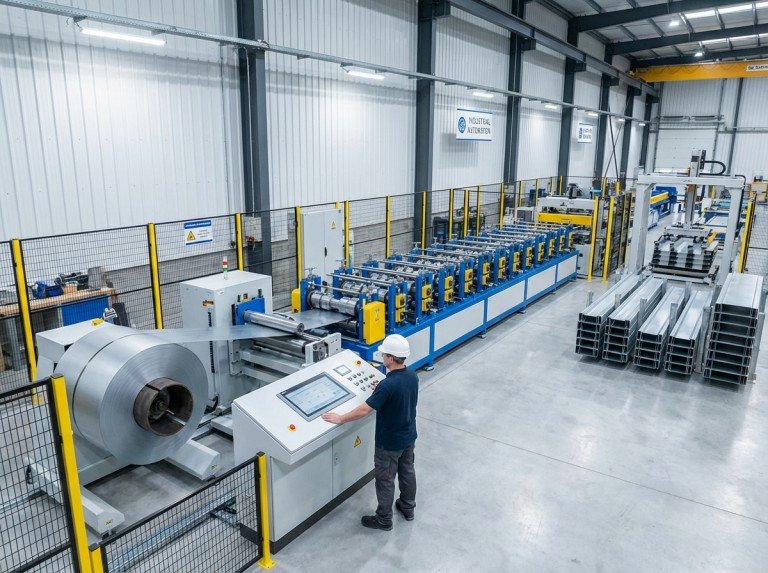
- Fully automatic: Powered decoiler with coil car, auto straightening, servo feed control, HMI touchscreen, automatic stacking—full production line investment with lowest per-piece labor cost
PLC brand selection also carries a downstream cost implication. We offer Siemens, Mitsubishi, and Allen-Bradley control platforms at a $5,000–$15,000 premium over domestic-brand PLCs, with major brands typically offering faster spare parts availability than niche suppliers—a distinction that becomes critical when the first control component failure occurs.
Inline Process Integration
Punching, notching, embossing, welding, and labeling integrated inline with the forming sequence eliminates downstream material handling and secondary processing labor. Each inline process module—whether a hydraulic punch press or servo-driven notch unit—adds $8,000–$30,000 depending on punch force requirements, hole pattern complexity, and cycle speed synchronization with the main forming line. We design integrated punching and welding modules as synchronized servo axes within the main line PLC to eliminate timing errors that cause hole position drift at higher line speeds.
Standalone Machine Price vs. Complete Line Cost: The $30,000–$60,000 Gap Most Buyers Miss
The standalone machine price for any roll forming configuration covers only the forming frame, roll tooling, and cutting unit—with a realistic complete integrated line cost running $30,000–$60,000 higher due to excluded components that every production line requires to function at specification throughput. We correct this misconception here because it is the most consistent source of capital shortfall we observe in buyer budgets.
Competitor articles frequently present C/Z purlin machines at $80,000–$150,000 without disclosing that the following items are typically excluded from the base quote:
- Powered decoiler and coil car: $8,000–$20,000 depending on coil weight capacity; often undersized on budget imports
- Material straightening and leveling stage: $5,000–$12,000; required for flatness tolerance compliance on structural profiles
- Finished product stacking or run-out table: $6,000–$15,000; manual stacking at this throughput eliminates the automated line speed advantage
- First tooling set: Some quotes include one profile; each additional profile tooling set costs $8,000–$20,000
- Commissioning and operator training: $3,000–$10,000 depending on technician travel distance and training duration
Common mistakes to avoid:
- Treating “automatic cutting included” language as confirmation of servo flying shear—it often refers to hydraulic cut-off at one-third the throughput
- Accepting “PLC control included” without named brand—generic firmware frequently requires $3,000–$8,000 in paid configuration post-purchase
- Assuming a quoted decoiler fits your heaviest production coil without verifying maximum coil weight capacity in kilograms
Hidden cost alert: In projects where we configured lines for buyers who had not verified maximum coil weight in their supply chain, undersized decoilers on $40,000–$60,000 imported machines caused repeated coil-jam downtime of 3–4 hours per incident, requiring either a decoiler retrofit at $8,000–$15,000 or a permanent production speed reduction to keep tension manageable. Specifying decoiler capacity against your heaviest coil weight is a non-negotiable line item in any serious quote.
Regional Sourcing and Price Differential: China vs. Domestic Manufacturers
Chinese-manufactured cold roll forming machines carry lower FOB prices than US- or European-built equivalents, but landed cost after international freight, import duties, and logistics narrows that advantage considerably—before spare parts lead time risk is factored. We supply machines from our Jiangsu manufacturing base and document these variables transparently so buyers can make total-cost sourcing decisions.
Chinese-manufactured C/Z purlin machines carry FOB (Free on Board, Chinese port) prices of $80,000–$150,000, compared to $120,000–$200,000 for US- or European-built equivalents. However, the landed cost of a $100,000 FOB machine typically reaches $120,000–$135,000 after ocean freight ($4,000–$10,000), import duties that vary by HS classification, country of origin, and current trade agreement status applicable at time of purchase—verify current rates with a licensed customs broker before finalizing your sourcing decision—plus customs clearance fees, inland transportation, and installation rigging.
Beyond landed cost, spare parts availability is the sourcing variable most commonly ignored at the quote stage. In our supply chain experience managing shipments from our Jiangsu manufacturing base, the first critical component failure—typically a servo encoder or drive board—arrives within 6–14 months of commissioning on high-duty lines. International spare parts procurement for Chinese-sourced machines involves longer lead times than domestic equivalents, with major control system brands offering meaningfully faster availability than niche suppliers. We mitigate this by recommending a first-order spare parts kit—servo drive boards, cutting blades, key encoder units—shipped with the machine to eliminate the production impact of the first critical failure event.
Used vs. New Roll Forming Machines: True Cost Comparison
Used roll forming machines sell at 40–60% of new equipment cost, but refurbishment, tooling replacement, and control system upgrades reduce effective savings—with the net advantage depending directly on the specific unit’s condition, age, and the scope of work required to reach production specification. We present this comparison so buyers can calculate the true cost of each path before committing.
A used machine purchased at $20,000–$40,000 may require $5,000–$15,000 in refurbishment before reaching production specification: roll tooling re-grinding or replacement, control system upgrade from relay logic to PLC, and mechanical alignment correction after years of wear. We assess used equipment condition using our in-house profiler and hardness testing equipment to verify roll surface condition and drive system integrity before recommending integration. The effective cost of a $20,000 used machine requiring 3 months for parts procurement and repair reaches $24,000–$28,000 when technician labor and production delay costs are included.
New machines from qualified manufacturers carry full tooling sets, calibrated to profile drawing tolerances, with control systems commissioned and tested on production material before shipment. For buyers where production continuity risk is high, new equipment eliminates the uncertainty cost that used machine acquisitions carry.
How to Verify a Cold Roll Forming Machine Quote
Quote verification for cold roll forming equipment depends on confirming that five non-negotiable specification items are explicitly stated in the vendor proposal—with omission of any single item indicating either an incomplete scope or a pricing structure that will generate change orders after purchase commitment. We apply this framework across all line proposals we receive from customers requesting competitive benchmarking.
- Decoiler weight capacity explicitly stated: If the quote does not specify maximum coil weight in kilograms, the decoiler is almost certainly undersized for industrial coil weights above 3,000–5,000 kg
- Cutting system type and speed rating confirmed: Hydraulic or servo flying shear must be specified with rated line speed in m/min—generic “automatic cutting” language does not confirm system type
- PLC brand and HMI type named: “PLC control included” without brand identification conceals control system quality; require Siemens, Mitsubishi, Allen-Bradley, or equivalent named specification
- Tooling profile count confirmed: Verify whether the quoted price includes one profile tooling set or multiple; additional sets at $8,000–$20,000 each are a significant budget variable
- Commissioning and training scope defined: On-site commissioning versus remote guidance versus documentation-only are materially different support levels that must be explicit
A quote missing any two of these five items is incomplete and should be returned to the vendor with a specification clarification request before any purchase decision proceeds.
ROI and Payback Period by Automation Tier: What the Numbers Require
Cold roll forming machine payback periods range from approximately 14 months on high-volume multi-shift automated lines with established supply contracts to 4–6 years on low-volume single-shift manual operations—depending on volume, margin per meter, and labor cost displacement. We model these scenarios against automation tier and cutting system selection as the two primary variables that determine where a given line falls in that range.
A mid-range C/Z purlin line at $150,000 complete (including decoiler, straightener, and stacking) running 2 shifts at 30 m/min with 80% uptime produces approximately 11,520 linear meters per day. At a market rate of $2.50–$4.00 per linear meter for structural purlin—a figure that varies directly with regional pricing, product specification, and supply contract terms—daily revenue capacity at those throughput and pricing assumptions reaches $28,800–$46,080, generating payback well within 12–18 months for shops with established supply contracts at those rates. We recommend operators targeting payback under 24 months prioritize servo cutting and automatic stacking to maintain throughput without proportional labor cost increase.
High-speed automated lines at $350,000–$500,000 require 4–8 weeks of operator ramp-up before reaching rated throughput. Buyers comparing an $80,000 manual machine to a $300,000 automated line without including training time and ramp-up labor cost in their ROI model typically miscalculate payback by 6–12 months—a gap that significantly distorts the investment case.
Conclusion
The $30,000–$60,000 gap between a base unit quote and a complete integrated line is the most consistent capital shortfall in roll forming procurement, and the five-point quote verification checklist in this guide is the most direct tool for closing it before purchase. Cold roll forming machine price decisions require evaluating total landed cost, integration scope, material compatibility range, and automation tier against production volume targets and payback requirements—not standalone machine price alone.
In our experience configuring lines across construction, automotive, and warehouse racking applications, we consistently find two verification gaps that production throughput targets expose: first, cutting system rated speed requires re-confirmation when buyers transition from low-volume manual operations to multi-shift automated production, because the stated machine speed and the achievable production speed under real coil and material conditions often differ by 15–25%; second, in projects where multi-material capability is specified without defining all material grades upfront, roll gap tolerance and tooling hardness requirements require re-verification against each material’s yield strength and coating thickness before line commissioning. Both gaps are preventable with the specification inputs and quote verification framework this guide provides.
To receive a line configuration proposal from our engineering team, share your target profile drawing, material grade and coating type, thickness range, required line speed in m/min, and daily production volume target. Our engineers will propose a roll forming line configuration with component-level pricing, integration scope, and preliminary layout within 48 hours of receiving your requirements.
Further Reading:What Is Cold Roll Forming Machine
FAQ
How much does a cold roll forming machine cost for a mid-range structural application?
A complete mid-range C/Z purlin line for structural steel fabrication costs $110,000–$310,000 depending on automation level, cutting system type, and integration scope. The $110,000–$310,000 range includes decoiler, forming unit, servo or hydraulic cutting, and basic stacking—base unit quotes without these components typically run $80,000–$250,000 and require additional budget allocation for completion.
What is the price difference between servo and hydraulic cutting systems?
Servo flying shear systems carry a significant capital premium over hydraulic cut-off systems—exact differential depends on line speed requirements and supplier platform—with servo systems enabling 40–80 m/min continuous forming compared to 15–30 m/min for hydraulic. The servo upgrade ROI typically breaks even within 18–24 months on high-volume lines running multiple shifts.
Does the quoted machine price include roll tooling for my profile?
Tooling inclusion varies by vendor and must be explicitly confirmed in the quote. Most base quotes include one tooling set for a single standard profile; each additional profile tooling set costs $8,000–$20,000 and is frequently excluded from initial pricing. Verify this line item before signing any purchase agreement.
What is included in total landed cost for a Chinese-manufactured roll forming machine?
Landed cost for a Chinese-manufactured machine includes FOB price plus ocean freight ($4,000–$10,000), import duties that vary by HS classification and trade agreement status applicable at time of purchase—verify current rates with a customs broker before finalizing sourcing—plus customs clearance fees, inland transportation, and installation rigging, typically adding $20,000–$35,000 to a $100,000 FOB machine before the unit reaches your production floor.
Can a used roll forming machine deliver acceptable ROI compared to new equipment?
Used machines at 40–60% of new cost can deliver adequate ROI when refurbishment requirements are minimal, but buyers should budget $5,000–$15,000 for tooling condition assessment, control system updates, and mechanical alignment before calculating payback. In projects where parts procurement delays exceed 8 weeks, the effective cost of production downtime eliminates the purchase price advantage.
What specifications must I provide to get an accurate roll forming machine quote?
An accurate quote requires your target profile drawing with dimensional tolerances, material grade and coating type, minimum and maximum material thickness, required line speed in m/min, daily production volume target, and any inline process requirements such as punching hole patterns or welding operations. Missing any of these inputs results in a generic quote that will generate change orders after purchase.